The lost royal courts of the Welsh princes: tracing the llys sites across the landscape
The lost royal courts of the Welsh princes: tracing the llys sites across the landscape
The royal courts of the medieval Welsh princes, known as llys (plural: llysoedd), once formed a vibrant political and cultural network across the landscape of Wales. Today, many of these courts survive only as earthworks, place-names or archaeological traces. Yet for visitors interested in Welsh history, these lost royal centres offer a compelling way to explore both the medieval past and the modern countryside. Tracing the llys sites of the Welsh princes means reading fields, rivers and hilltops as a historical text: a fragile but still legible record of power, law and identity in medieval Wales.
What was a llys? Understanding the Welsh royal court
The word llys in Welsh can mean “court”, “palace” or “hall”, and in the Middle Ages it referred specifically to the royal courts of the native Welsh princes. Unlike the single, monumental castles favoured by Norman lords, Welsh rulers maintained a constellation of court sites spread across their territories. These were not simply residences; they were hubs of government, justice and ceremony.
At a medieval llys, a prince would:
- Hold legal assemblies and arbitration sessions under the Welsh law codes
- Receive tribute and host foreign envoys and church leaders
- Oversee military planning and regional administration
- Celebrate religious feasts and festivals with bardic performances
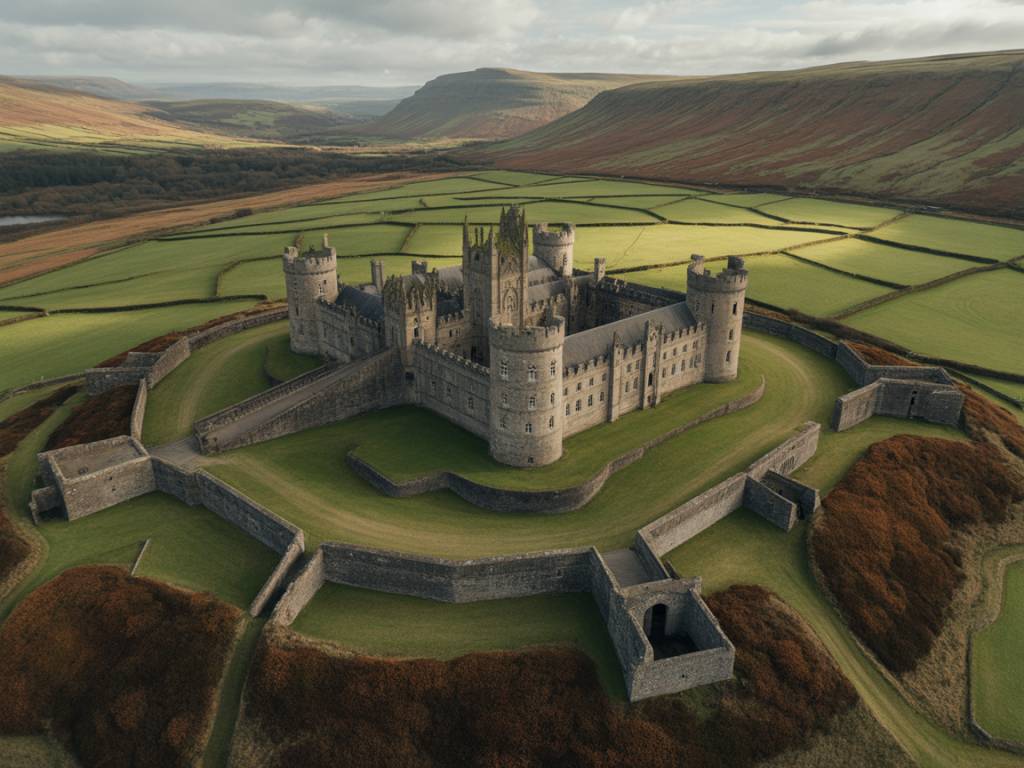
The architecture of a llys was often modest in comparison to the great stone castles of Anglo-Norman lords. Early llysoedd might consist of timber halls, smaller domestic buildings, livestock enclosures and sometimes a church, all enclosed within a boundary bank or palisade. Over time, some sites developed stone buildings, especially where royal and ecclesiastical functions intertwined. Yet many royal courts remained relatively understated, blending into the agricultural landscape rather than dominating it.
A political landscape: the llysoedd of the Welsh princes
The Welsh principalities of Gwynedd, Powys and Deheubarth were not governed from a single capital city. Instead, princes circulated around their territories, staying at different llysoedd according to the season, political needs and regional obligations. This itinerant model created a political geography whose traces can still be followed through maps, place-names and archaeological surveys.
The main Welsh principalities each had their own constellation of courts:
- Gwynedd: in north-west Wales, associated with famous princes such as Llywelyn the Great and Llywelyn ap Gruffudd, maintained a series of court sites stretching from Anglesey to the Conwy valley.
- Powys: occupying central and eastern Wales, centred on the Severn valley and borderlands with England, had llysoedd that reflected both upland pastoral economies and lowland arable heartlands.
- Deheubarth: in south-west Wales, embraced the kingdoms of Dyfed and Ceredigion, with courts linked to coastal trade routes and monastic centres.
Because Llywelyn ap Gruffudd’s Gwynedd was the last major native principality to resist English control, more effort has been invested by historians and archaeologists in mapping its royal courts. However, research throughout Wales is continuously bringing new llys sites to light, often through a combination of aerial photography, geophysical survey and re-examination of medieval documents.
Reading the landscape: how to identify a llys site
For heritage travellers and enthusiasts of medieval history, one of the most rewarding aspects of exploring llys sites is learning to “read” subtle signs in the landscape. Unlike castle tourism, which usually focuses on monumental ruins, the search for Welsh royal courts often leads to quieter, less obvious places.
Key indicators of a potential llys site include:
- Place-names containing llys, maerdref (“steward’s settlement”), or references to princes and kings.
- Low, regular earthworks forming rectangular platforms or enclosures in otherwise open fields.
- Proximity to early churches or monasteries, reflecting the close ties between royal and ecclesiastical power.
- Strategic locations overlooking river crossings, fertile valleys or traditional routeways.
- Documentary references in medieval chronicles and charters, sometimes matching modern locations.
Modern archaeological techniques such as LiDAR (Light Detection and Ranging) and magnetometry are revealing buried ditches, building platforms and boundaries that help to confirm suspected court sites. For visitors, interpretive panels, online resources and guidebooks increasingly highlight these discoveries, allowing travellers to connect specialist research with on-the-ground exploration.
Key llys sites linked to the princes of Gwynedd
Among the most evocative destinations for those tracing the royal courts of the Welsh princes are the sites associated with the rulers of Gwynedd. Here, the landscape of Snowdonia and the Menai Strait frames a dense cluster of historical locations.
Aberffraw, Anglesey
Once the principal seat of the kings of Gwynedd in the early medieval period, Aberffraw on the island of Anglesey is often described as the earliest “capital” of Wales. While little survives above ground of the royal court, the setting still communicates its former importance: a coastal landscape of dunes, tidal channels and pasture facing the Irish Sea.
Visitors will find:
- Traces of earthworks and field patterns hinting at earlier high-status occupation
- The nearby church of St Beuno, with associations to early Welsh Christianity
- A wider historical landscape incorporating prehistoric and early medieval sites
Llys Rhosyr, Newborough, Anglesey
Perhaps the best-known excavated llys, Llys Rhosyr near Newborough offers tangible archaeological evidence of a royal court from the era of Llywelyn the Great. Sandstorm events in the Middle Ages helped preserve the site beneath dunes, allowing later excavations to uncover stone and timber buildings arranged around courtyards.
The site provides:
- Visible foundations of halls, stores and domestic structures
- Interpretive signage explaining the role of the court in the administration of Anglesey
- Connections to the coastal environment and the shifting sands that reshaped the settlement
Abergwyngregyn, near Bangor
Abergwyngregyn, often simply called “Aber”, is associated with the later princes of Gwynedd, including Llywelyn ap Gruffudd and his family. The llys itself is not dramatically preserved, but archaeological research has revealed a complex settlement, including large halls and ancillary buildings.
Today, visitors encounter:
- A small village set in a deep valley heading into the Carneddau mountains
- Signposted walks leading through a landscape rich in medieval and post-medieval remains
- A sense of how a royal court functioned in a rural setting combining agriculture, hunting and administration
Beyond Gwynedd: llys sites in Powys and Deheubarth
While Gwynedd receives much of the attention in narratives about the Welsh princes, the royal courts of Powys and Deheubarth also offer rich opportunities for heritage tourism and historical reflection.
Mathrafal, Powys
Mathrafal served as an important royal centre for the princes of Powys. Located near the river Vyrnwy, the site features earthworks that hint at a defended enclosure, possibly including timber halls and service buildings.
For visitors, the appeal lies as much in the sense of place as in visible remains. Exploring Mathrafal allows one to imagine a border principality negotiating its position between the English Marcher lords and other Welsh dynasties.
Dinefwr, Carmarthenshire
Dinefwr Castle and its surrounding park in Carmarthenshire form one of the most atmospheric royal landscapes in south-west Wales. Though better known as a stone castle, Dinefwr is deeply connected to the rulers of Deheubarth and may have earlier phases as a royal court predating the masonry fortifications.
Today, the Dinefwr estate offers:
- A hilltop castle with panoramic views over the Tywi valley
- Wooded parkland and veteran trees reflecting centuries of elite land use
- Interpretation linking the site to Rhys ap Gruffydd and the politics of twelfth-century Wales
Visiting llys sites: practical tips for heritage travellers
Because many llys sites are subtle and sometimes lie on private land, planning is essential for anyone wishing to explore these royal courts responsibly.
- Research in advance: Many llys locations are identified in guidebooks, academic articles and specialist websites on Welsh archaeology and medieval history. Checking these sources helps distinguish confirmed sites from speculative ones.
- Respect access and farming activity: Always follow public rights of way and observe local signage. Many earthworks lie in working fields; visiting outside of busy agricultural seasons reduces disturbance.
- Use Ordnance Survey maps: Detailed mapping often marks earthworks, churches and historical place-names, helping travellers link physical features to medieval records.
- Combine with nearby attractions: Many llys sites are close to castles, standing stones, early churches or museums, allowing for richer itineraries that weave together different periods of Welsh history.
- Seek local knowledge: Community heritage groups, local historians and small museums often hold insights not yet widely published, as well as information on access and seasonal conditions.
Llys sites, identity and the Welsh historic environment
Exploring the lost royal courts of the Welsh princes is not only an exercise in medieval tourism; it is also a journey into the ongoing debates about identity, sovereignty and heritage in Wales. The llysoedd represent a native tradition of governance that coexisted and later collided with Norman and English models of lordship. After the conquest of 1282–83 and the integration of Wales into the English crown’s domains, many court sites declined in status or were repurposed, their memory persisting mainly in local tradition and literature.
Recent decades have seen renewed interest in these royal centres as part of a broader re-evaluation of Welsh medieval history. Heritage organisations, universities and local volunteers collaborate to map, protect and interpret llys sites as key elements of the historic environment. For visitors, this means increasing opportunities to engage with well-researched trails, interpretive panels and digital resources that bring these understated but significant places back to life.
Walking a field edge where a prince once held court invites reflection on the continuity of landscape and the fragility of political power. The absence of towering ruins forces the imagination to work harder, but it also encourages a more intimate connection with the terrain itself. In following the scattered royal courts of the Welsh princes, travellers encounter not just the remnants of a medieval state, but also a living countryside where history and daily life still intersect.