The slate quarries of Wales: how stone shaped communities and landscapes
The slate quarries of Wales: how stone shaped communities and landscapes
The slate quarries of Wales: how stone shaped communities and landscapes
Across the mountains of North Wales, entire valleys bear the marks of a single material: slate. The slate quarries of Wales not only supplied roofing for Britain and the wider world, they also forged distinctive industrial landscapes and close-knit communities. Today, these former centres of heavy industry are places of heritage tourism, walking routes and cultural rediscovery, where visitors can trace how stone shaped both people and place.
The rise of the Welsh slate industry
Welsh slate has been quarried since the Roman period, but it was the 18th and 19th centuries that transformed it into a global industry. With the expansion of towns and cities across Britain and the British Empire, the demand for durable, weather-resistant roofing grew rapidly. Slate from the mountains of Gwynedd and beyond became a defining building material of the Industrial Revolution.
By the late 19th century, Wales was one of the world’s leading producers of roofing slate. Places such as Blaenau Ffestiniog, Llanberis and Bethesda were synonymous with high-quality stone. At its peak, the Welsh slate industry employed tens of thousands of men and exported to Europe, North America, Australia and South America. Roofs from Liverpool to Buenos Aires and Melbourne were tiled with slate cut in the quarries of Snowdonia.
The growth of the slate quarries was closely tied to new transport links. Narrow-gauge railways, like the Ffestiniog Railway and Padarn Railway, connected remote mountain quarries to coastal ports such as Porthmadog. These railways transformed the landscape with embankments, tunnels and viaducts, while also knitting quarry communities more tightly into the wider world.
Iconic slate landscapes of North Wales
The most striking slate landscapes lie within what is now the Eryri (Snowdonia) National Park and its surrounding areas. Here, visitors can see how industrial extraction reshaped valleys and mountainsides, creating a unique fusion of natural and man-made features.
Key slate quarry regions include:
- Llanberis (Dinorwig Quarry) – Terraced cliffs, vast slate tips and abandoned buildings cascade down towards Llyn Padarn, forming one of the most dramatic post-industrial landscapes in Europe.
- Blaenau Ffestiniog – Once known as the “slate capital of the world”, the town is surrounded by jagged waste tips and gaping quarry pits, creating a stark, almost lunar panorama.
- Bethesda (Penrhyn Quarry) – This enormous open quarry carved deep into the mountainside became one of the largest slate quarries on earth, a monument to industrial ambition and human labour.
- Nantlle Valley – Smaller quarries scattered among farms and fields illustrate the layered relationship between industry and agriculture in rural Wales.
These slate landscapes are now recognised as a cultural treasure. In 2021, the “Slate Landscape of Northwest Wales” was inscribed as a UNESCO World Heritage Site, underlining its international significance as an industrial and cultural landscape. The designation highlights how quarrying altered the environment on a massive scale, while leaving a distinctive beauty in its wake.
Life in the quarrying communities
The Welsh slate quarries were not just workplaces; they were at the heart of local society. Villages grew up around the workings, consisting of simple terraced cottages, chapels, schools and modest high streets. Daily life was shaped by the rhythms of the quarry, the whistle signalling the start and end of long shifts.
Working in the slate industry was tough, skilled and often dangerous. Men laboured as rockmen, splitters, dressers, sawyers and blacksmiths. The work demanded expertise: extracting huge blocks of rock, splitting them along natural cleavage lines, and turning them into thin, regular roofing slates. Accidents, rockfalls and health problems from dust were common hazards.
Despite these challenges, a strong sense of community identity emerged. The slate villages became centres of Welsh language, Nonconformist religion and political activism. Chapels played a central role, offering education, social activities and a forum for debate. Trade unionism grew within the quarries, with prolonged disputes such as the Penrhyn Lockout (1900–1903) leaving deep marks on local memory.
The Welsh language remained the everyday medium of communication in these communities. Quarry workers developed their own technical vocabulary around slate, and their songs, stories and poetry reflected the hardships and solidarities of the industry. For visitors today, this cultural dimension is as important as the physical landscape.
From industrial powerhouses to heritage attractions
The 20th century brought decline. Alternative roofing materials, changing building styles and economic shifts reduced demand for slate. Many Welsh quarries closed, leaving towering waste tips, rusting machinery and silent workshops. Communities faced unemployment and out-migration, while the environment bore the scars of extraction.
From the late 20th century onwards, however, a different story began to emerge. Local authorities, heritage organisations and community groups recognised the significance of the slate industry for Welsh history and identity. Rather than viewing the quarries as abandoned eyesores, they began to valorise them as heritage landscapes and tourism resources.
Today, visitors can explore a wide range of slate-related attractions, including:
- National Slate Museum, Llanberis – Housed in the former Dinorwig quarry workshops, this museum preserves foundries, cranes and machinery, offering immersive displays on quarry techniques and workers’ lives.
- Llechwedd Slate Caverns, Blaenau Ffestiniog – Underground tours take visitors deep into former workings, using sound, light and storytelling to bring the history of slate mining to life.
- Ffestiniog and Welsh Highland Railways – Heritage steam trains run on lines originally built to carry slate, now transporting tourists through the scenic valleys of Snowdonia.
- Zip World at Penrhyn and Llechwedd – Adventure tourism has found a home among the old quarries, with zip lines and underground trampolines repurposing industrial spaces in innovative ways.
These projects have created jobs and renewed pride in local heritage, demonstrating how former extraction sites can become drivers of sustainable tourism and economic regeneration.
Walking through industrial heritage
For travellers interested in outdoor activities, the slate quarries of Wales provide an unusual combination of hiking, history and landscape photography. Many former workings are threaded with footpaths, old tramways and miners’ tracks that now serve as walking and cycling routes.
Popular experiences include:
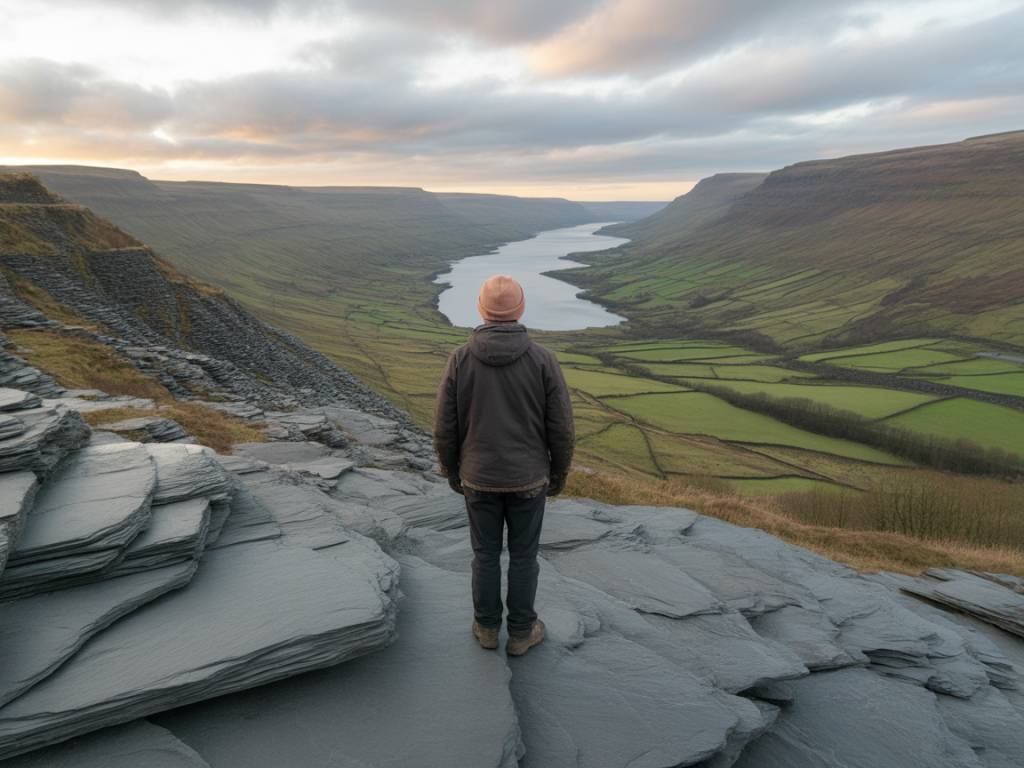
- Climbing the slate-scarred slopes above Llanberis to look down on Llyn Padarn, the Dinorwig terraces and the distant summit of Yr Wyddfa (Snowdon).
- Following waymarked trails around Blaenau Ffestiniog, where interpretation boards explain how each heap of spoil and ruined building fits into the story of slate.
- Exploring the Nantlle Valley on quieter paths, where small quarries sit beside fields and farmsteads, highlighting the blend of rural life and industry.
- Walking along former quarry railways, where level tracks and gentle gradients reveal how slate once travelled from mountain to harbour.
These routes show that industrial heritage is not separate from the natural environment. In many places, mosses, lichens and birch trees now cling to the slate tips, while ponds fill old pits. Birds nest in quarry faces and sheep graze among ruined buildings. The interaction of nature and human intervention lends the Welsh slate landscape a distinctive character.
Slate, identity and the Welsh language
The story of the Welsh slate quarries is also a story of language and identity. For many communities in Gwynedd and beyond, slate was the economic backbone that allowed Welsh-speaking culture to flourish well into the 20th century. Wages paid in the quarry supported local shops, chapels, choirs and Eisteddfodau (cultural festivals).
As visitors move through these landscapes today, they encounter place-names and signage in Welsh as well as English. Names such as Dinorwig, Cwmorthin, Penrhyn and Llechwedd carry centuries of meaning, linking modern tourism sites to older patterns of settlement and land use. Interpreting the slate quarries is therefore not only about machinery and geology, but also about preserving and sharing an intangible cultural heritage.
Guided tours, museum exhibitions and local festivals increasingly highlight this dimension. Oral history projects record the voices of former quarrymen and their families, while schools and community groups use the quarry heritage to teach younger generations about their region’s past. In this way, the slate industry remains woven into the fabric of contemporary Welsh life.
Planning a visit to the Welsh slate quarries
For those interested in industrial heritage, cultural tourism or mountain landscapes, the Welsh slate regions offer varied and accessible experiences. When planning a visit, it is worth considering:
- Season – The mountains of North Wales can be wet and windy, but spring and autumn often offer clear light ideal for photography. Summer brings longer days and more visitor services.
- Transport – Public transport links exist, particularly to hubs like Bangor and Porthmadog, but many quarry sites are most easily reached by car. Heritage railways offer a memorable alternative for certain routes.
- Safety – While marked trails and organised attractions are generally safe, old quarry workings can be hazardous if explored off-path. Steep drops, unstable spoil heaps and hidden shafts demand caution.
- Local engagement – Using local guides, staying in community-run accommodation and visiting independent cafés and shops help ensure that tourism benefits the people who live in these landscapes.
For travellers interested in sustainable tourism, the Welsh slate quarries demonstrate how industrial sites can be sensitively reused. The balance between visitor access, safety, environmental protection and respect for local communities is an ongoing process, but one that offers valuable lessons for other regions with similar histories.
Stone, memory and a living landscape
The slate quarries of Wales are more than relics of a vanished industry. They are places where geology, labour, language and landscape intersect. Slate shaped the skylines of distant cities, but it also shaped the intimate geographies of villages and valleys in Gwynedd and beyond. Terraces of workers’ cottages, chapel spires, railway embankments and towering waste tips together form a cultural landscape that is both fragile and enduring.
For visitors, walking among the slate tips and abandoned inclines offers more than a lesson in industrial history. It is an invitation to reflect on how human societies extract and value natural resources, and how these decisions leave long-lasting marks on the land. In the Welsh slate country, those marks have become part of a new story, one in which heritage, tourism and community renewal are closely intertwined.